35+ Journal Prompts for Healing the Inner Child
Your inner child is the part of you still shaped by childhood. It holds onto old fears, unspoken beliefs, and needs that were never fully met. Journal prompts for healing the inner child help you understand unmet needs and find patterns that might be holding you back, so you can move forward.
You're not alone in carrying this kind of pain. According to a national CDC survey, nearly two out of three adults in the U.S. report at least one adverse childhood experience, and about one in five report four or more.
As a licensed therapist and mother-daughter coach, I've helped many clients reconnect with their younger selves and start healing long-held pain.
Below, you'll find prompts that can help you process emotions, rewrite limiting beliefs, build self-compassion, and shift unproductive patterns that still show up in your relationships today.

Why Journaling Helps Heal the Inner Child
Your inner child can hold onto unresolved pain. Journaling provides a safe outlet to process this pain.
A 2021 review published in Psychological Medicine studied more than 7,700 participants. It found that writing about painful experiences produced meaningful improvements in trauma symptoms. The impact was even better when paired with support from a mental health professional.
Writing by hand gives your brain a new kind of input. Instead of replaying a memory in your head, you put it into words on paper. This shift can help your brain process childhood experiences differently than simply thinking about them..
This is the idea behind journal prompts for healing the inner child. They give old pain a safe, structured place to go, instead of letting it run quietly in the background of your life. Journaling can also help you work through generational cycles, connect with your inner child, and improve your overall well-being.
Inner Child Journal Prompts to Reconnect With Your Younger Self
Before you can heal your inner child, you need to find her. These prompts help you reconnect with the version of you who is still waiting to be heard.
What is your earliest clear childhood memory? Describe the experience and how you feel about it.
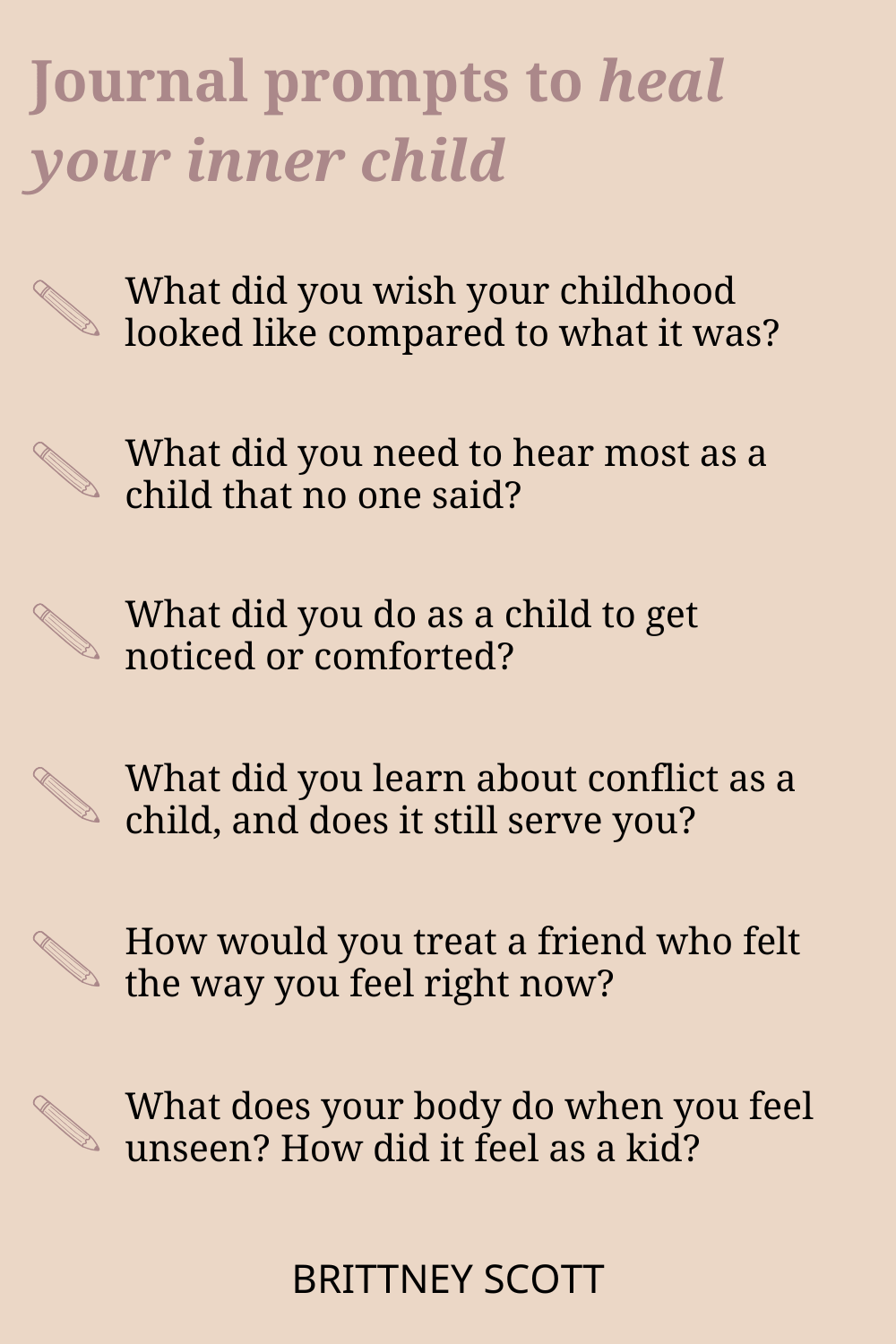
What did you wish your childhood looked like compared to what it was?
What did you love to do as a child that you've since let go of?
Describe a moment you felt completely safe as a kid. Where were you, and who was there?
What did you need to hear most as a child that no one said?
If you could see a photo of yourself at age seven, what would you want to tell her?
What parts of yourself did you hide to keep the people around you comfortable?
What did your younger self believe about love, and where did that belief come from?
Inner Child Journal Prompts for Processing Emotions & Unmet Needs
Unmet needs are often at the center of a wounded inner child. These prompts help you name what was missing, so you can start giving it to yourself now.
Which emotions weren’t welcome in your home growing up?
What did you do as a child to get noticed or seek comfort?
What need went unmet most often, and how did you learn to live without it?
When you feel anxious now, what age does it feel like you're protecting?
What would your younger self say if she could finally speak without fear?
Whose feelings did you learn to manage instead of your own?
What do you wish someone had asked you when you were upset as a child?
Inner Child Journal Prompts for Rewriting Core Beliefs & Old Patterns
Oftentimes, our beliefs in childhood may never have been true, but they felt true because you learned them so early. These prompts help you trace where a belief started, so you can decide if it still belongs in your life.
What belief about yourself feels outdated, but still lingers?
Where did you first learn that belief, and was it ever accurate?
What pattern keeps repeating in your relationships, no matter who you're with?
What would change if you assumed you were lovable exactly as you are?
What did you learn about conflict as a child, and does it still serve you?
What rule did you create as a kid to stay safe that no longer serves you?
If a friend held the same belief you hold about yourself, what would you tell her?
Inner Child Journal Prompts for Self-Worth & Self-Compassion
Self-worth often gets tangled up with old criticism instead of how you actually want to feel about yourself. In a study examining more than 2,000 people, psychologist Kristin Neff found that self-compassion is associated with more stable feelings of self-worth than self-esteem because it depends less on social comparison and external validation. These prompts help you strengthen your self-worth and self-compassion, rather than chasing self-esteem.
What criticism from childhood do you still repeat to yourself?
What did you have to do or be to feel accepted growing up?
How do you treat yourself during moments of failure?
What is one kind sentence you can offer yourself today?
How would you treat a friend who felt the way you feel right now?
What does your inner child need to hear to feel safe being imperfect?
Write a short letter from your adult self to your younger self. What do you want her to know?
Inner Child Journal Prompts for Healing Current Relationships & Triggers
Inner child wounds rarely stay in the past. They show up in present-day relationships, often as reactions that feel bigger than the moment calls for. These prompts help you trace a trigger back to its root, so you can respond instead of react.
What kind of moments trigger a reaction that feels bigger than the situation?
When you feel triggered, what age do you feel like you're reacting from?
What boundary would protect your inner child in your closest relationship?
Which relationship patterns are you ready to stop repeating?
How do you respond when you feel left out or ignored?
What does your body do when you feel unseen? How did it feel as a kid?
What would it look like to give your inner child the relationship she needed back then?
Check out this video to learn more about how your childhood might be running your adult relationships:
FAQs
What does it mean to heal your inner child?
Healing your inner child means addressing old wounds from childhood that still shape how you think, feel, and react today. This often involves reparenting: giving yourself the comfort, validation, or safety you needed as a kid, but didn't fully receive. It isn't about blaming anyone. It's about meeting your own needs today.
Why is it important to heal your inner child?
Unresolved childhood pain doesn't stay in the past. It shapes your self-worth, your relationships, and how you handle stress as an adult. Left unaddressed, these patterns tend to repeat instead of resolve on their own.
How long does it take to heal your inner child?
There's no set timeline for healing your inner child. For some people, it takes months of consistent reflection. For others, it's an ongoing practice that requires support through therapy or coaching.
What changes when you heal your inner child?
When you heal your inner child, large reactions to small triggers tend to ease. Self-criticism softens. Relationships often start to feel safer, since you're no longer protecting old wounds inside new connections.
Get Support Healing Your Inner Child
These journal prompts for healing the inner child aren't meant to be completed in one sitting. Return to these journal prompts to heal your inner child whenever childhood patterns resurface.
If you're ready for more support, I'd love to help. I offer one-to-one, mother-daughter, and group coaching to help you heal and build healthier relationships, including your relationship with yourself. Reach out for a free consultation to find the right kind of support for you.
If you're also working through a painful mother-daughter relationship and prefer to start on your own, check out the Break the Cycle workbook. This six-part journey will take you beyond understanding and into transformation in order to help you discover healing and meaningful change.