30+ Mother Wound Journal Prompts to Support Healing
Healing from a mother wound is possible and journaling can and should be a part of the work you do. To put it simply, a mother wound forms when emotional support is absent from the mother-daughter relationship. However, it does go deeper than that, and mother wound journal prompts can help you explore this.
Journaling can support your healing journey by helping you identify where the pain is and what’s being triggered. As a licensed therapist and coach who focuses on mother daughter relationships, I have helped many women identify what their mother wound is telling them and how to heal that part of themselves.
Below, I’ll share journal prompts you can immediately use to process your emotions, rewire core beliefs, trust yourself, and find your voice.

Why Journaling Helps Heal the Mother Wound
The mother wound is a relational trauma created when a daughter experiences pain and harm from her mother. If you’re carrying a mother wound, journaling can help you process your pain and trauma by managing and learning from the experience. It also gives your brain new input by physically writing words on paper. This helps your brain process the same information, but through a different medium. Journaling can also help you break generational cycles, nurture your inner child, and improve your overall well-being.
Mother Wound Journal Prompts: Understanding Your Relationship With Your Mother
The first step to healing a mother wound is being able to accept the mother you received. It wasn’t what you deserved, but it’s what you got and once you accept the difference between the two, healing can begin. These journal prompts will help you with this first step.
When you think about a great mom, what do you imagine and how was your mother different from that?
How was conflict handled between you and your mom?
What did emotional support look like between you and your mom? (This answer may be how you emotionally supported her instead of the other way around.)
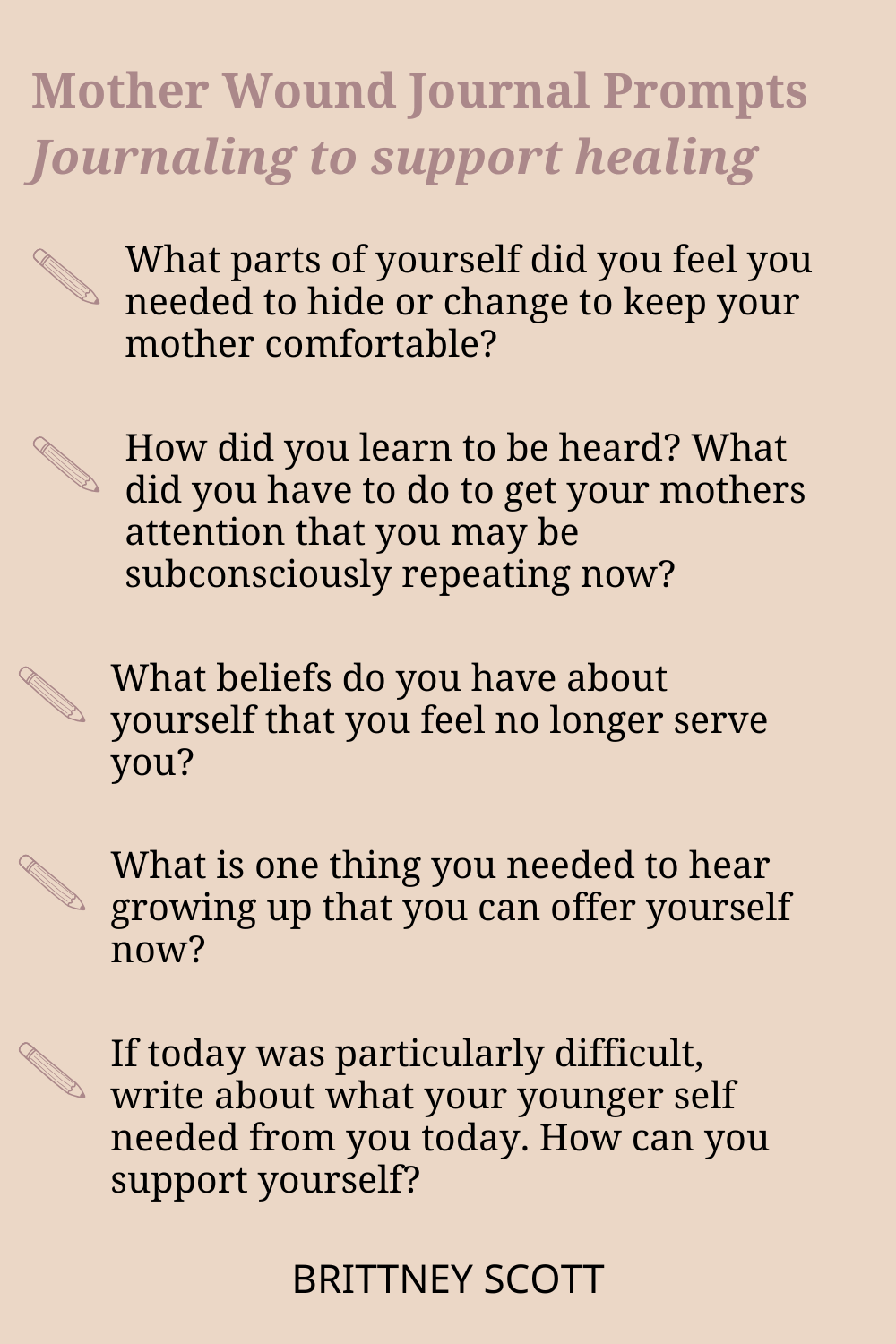
What parts of yourself did you feel you needed to hide or change to keep your mother comfortable?
When you think about the mother you deserved versus the mother you got, what hurts the most?
Do you still desire to have a relationship with your mother? If yes, what do you need to feel safe around her? If not, how will you take care of yourself and create safe relationships with other people?
Mother Wound Journal Prompts: Processing Emotions & Unmet Needs
Unmet needs are the cornerstones of a mother wound. Your mother was unable to meet your needs and probably left you feeling broken or unfinished. These journal prompts will help you uncover those gaps in your development so you can fill them in.
When you think about your childhood, which emotions feel the hardest to sit with and why?
What could your mom have said that would have made all the difference?
We all have needs inside of relationships: physical, emotional, financial, time, etc. Think about relationships, what do YOU need from them?
What does it sound like when you attempt to get a need met? Are you shy, firm, aggressive, etc?
How did you learn to be heard? What did you have to do to get your mothers attention that you may be subconsciously repeating now?
Were there emotions you weren’t allowed to express?
What emotions of your mothers did you have to take care of?
Mother Wound Journal Prompts: Rewriting Core Beliefs & Old Patterns
Mothers wounds are created when you’re a child, so you hold onto those patterns and beliefs because that's how your brain was wired. The good news is that you can re-wire these beliefs and create patterns that serve who you are today. These journal prompts will help you with that.
What beliefs do you have about yourself that you feel no longer serve you?
What did your mom teach you (intentionally or unintentionally) about friendships and how to treat others?
How do you respond to conflict in your current relationships (work, platonic, romantic, familial)?
What do you want and think you deserve from those you choose to have relationships with?
What patterns keep showing up inside of your relationships? Are these painful patterns or healthy ones?
What did you learn about love from your mom, either through what she said or what you watched her do?
Mother Wound Journal Prompts: Improving Self-Worth & Self-Compassion
Your self worth and self compassion is often tied to what you believed about yourself as a child — and often tied to how your mother made you feel. If she couldn’t love or see you, I bet it was hard to love or see yourself. These prompts will help you overcome this and improve your self esteem and compassion.
What is one thing you needed to hear growing up that you can offer yourself now?
What criticisms about yourself did you hear growing up that you need to let go of?
If you are critical of yourself, where did you learn it?
What phrase(s) can you tell yourself now that would feel like a hug to your younger self?
What 3 things can you change to begin being kinder to yourself and showing compassion?
Create 3 affirmations that remind you of who you truly are, not the criticism you were fed.
Talk to the little girl inside of you, and tell her she’s safe now because you’re the adult she needed. What does your younger self need you to tell her?
Mother Wound Journal Prompts: Healing Daily Interactions & Current Relationships
Mother wounds are childhood wounds that show up to disrupt adult relationships. What you learned and felt as a child is triggered as an adult. These journal prompts will help you become aware of your triggers and start to heal.
Which current relationship triggers an old pattern, and what boundary might feel helpful?
What dynamics continue to cause you pain or harm in your relationships?
How do you respond to feelings of abandonment?
How do you respond to fear?
What emotions do you run from that you can learn to sit with?
If today was particularly difficult, write about what your younger self needed from you today. How can you support yourself?
What are your triggers, can you identify them?
How Parents Can Journal With Their Teen
Journaling with your teen or pre-teen can create a stronger relationship and healthier connections. Conversations can be hard to have and it can be scary for your teen to wonder how you’ll react. Journaling creates a safe, quiet space to communicate emotions, thoughts, and events that are happening for your teen and in her life — which can help prevent a mother wound in her as she grows older.
Talk to your teen about starting a journal for the two of you to share. Make an experience of it by taking her to the store to help pick it out — pens, too. If she seems hesitant or not interested, do it anyway.
Create a set of rules for the journalFor example, if the journal hasn’t been given back after a specific number of days, it’s ok to check in about it. It won’t be used as punishment or shamed and the contents of the journal will not be shared. This should be about trust and connection.
In this journal, you'll start connecting with her and building up to bigger topics. Ask about her day, about a big project, or about her friends. You can also tell her about you, share stories from your childhood, share things you're proud of her for. The more open you are with her, the more open she can learn to be with you. The more she trusts you, the more she will tell you about what is happening and the less she will hide from you.
Here are some examples of what you can journal about with your teen:
Who in your friend group is most likely to ________. (go to college for sports, become the valedictorian, is the funniest). You can build on this as trust grows.
I’d love it if you would share some of your fears with me. Here are a few of mine when I was your age.
What was the best part of your day/week and what was the hardest part of your day/week?
What is something I do or say that breaks our connection? I’d like to change it or stop it so our relationship always feels good.
Can you share your birthday and holiday wish list?
Have her outline the perfect YES day — and maybe one day, they will get to experience their yes day.
The goal of the journal is to create a safety and comfort in her coming to you about big things. You always want to be the person she trusts and feels safe with — which is how we help prevent the mother wound in our children.
How to Journal for Ongoing Healing
Journaling doesn’t have to be perfect or look the same for everyone. It should feel good for you — whether that’s creating a list, writing full thoughts out, or even doodling while sitting with a difficult emotion.
In my perspective, journaling should be old school, pencil and paper, which allows you to take a break from screens and use your hands. When journaling, the goal is to give your brain new stimuli and a new input to process (i.e., the words or drawings on the paper).
Get Support Healing the Mother Wound
If you’re looking for support as you heal your mother wound or improve your own mother-daughter relationship, I’d love to help.
I offer one-to-one, mother-daughter, and group coaching to help you heal and improve your relationships. Reach out for a free consultation to learn about working together or which support might be best for you.